


A BRIEF HISTORY OF CHARTREUSE

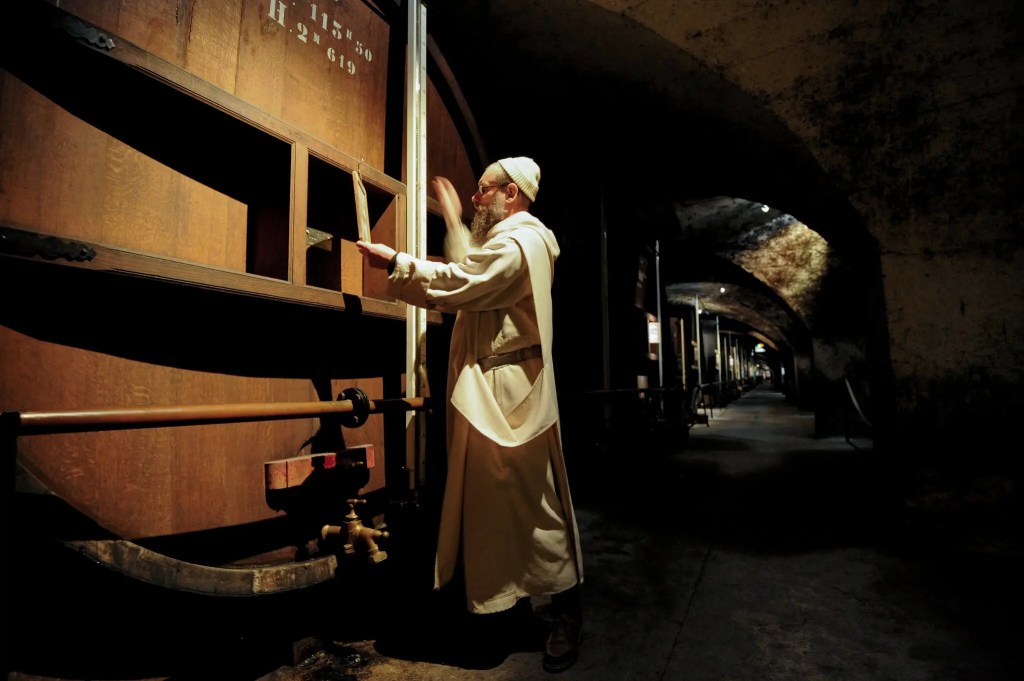
The Carthusian monastery was founded in 1084 by St. Bruno and six of his companions in what are now the Chartreuse Mountains, located north of Grenoble. It was in these mountains that St. Bruno found his “desert” and established a hermitage in order to live a semi-eremitic life devoted to prayer and contemplation, within the silence of the monastery. Alongside their spiritual pursuits, the monks also developed a wrought-iron industry and became renowned for the exceptional quality of their swords. So sharp and strong were these weapons that armies throughout Europe commissioned them to produce arms made to order.
In 1605, François Hannibal d’Estrées, Maréchal de France and a friend of Henry IV, entrusted the Carthusian monks of Paris—known for their knowledge and expertise, particularly in apothecary—with a document whose origins remain mysterious. It contained a secret recipe using 130 herbs, distilled into an alcoholic preparation called the Elixir de Vie Prolongé.
In 1614, an apothecary was established at the Parisian monastery of Vauvert under the responsibility of Brother Claude Obriot, allowing the monks to further refine their work with medicinal plants. Despite years of effort, they were unable to find the perfect balance for the elixir described in the manuscript. After a stay in Paris in 1736, Dom Michel Brunier de Larnage rediscovered the manuscript. When he became General of the Order at the Grande Chartreuse in 1737, he requested that the document be transferred there.
Brothers Bruno and André later developed a new formula, which resulted in a red-colored elixir. After their deaths, their successor, the apothecary Brother Jérôme Maubec, finally achieved a satisfactory result in 1755 and recorded it in the manuscript, specifying: “It must never leave the house, Reverend Father.” Following Brother Jérôme Maubec’s death in 1762, the monks began to commercialize the elixir through their pharmacy. Distribution was carried out by a brother traveling on muleback, which limited sales to the nearby cities of Grenoble and Chambéry, where it quickly gained popularity. This elixir is still produced today under the name Elixir Végétal de la Grande Chartreuse.
From this elixir, Green Chartreuse as we know it was eventually created by Brother Antoine Dupuy, whose method produced a naturally green hue and a distinctive flavor. In 1764, this process—comprising seven successive operations—was recorded in a new seven-page manuscript titled “Composition of the Elixir of Chartreuse.”
In 1793, during the French Revolution, the monks were officially exiled from France and were only able to return after Napoleon’s exile. Upon their return, they resumed distillation in 1812. They eventually decided to commercialize the liqueur, which until then had been used solely for medicinal purposes. Thus, in 1840, the first Green Chartreuse—also known as liqueur de santé (health liqueur)—appeared on the open market. Around this same period (either 1838 or 1840), a milder version was created: Yellow Chartreuse, nicknamed the “Queen of Liqueurs.” The monks decided to commercialize both varieties, and sales quickly grew, eventually reaching $400,000 annually by 1874.
On November 20, 1852, Louis Garnier officially registered the Chartreuse brand on behalf of the Carthusians. He renewed this registration in 1869 to protect it against the growing number of counterfeit Chartreuse bottles.
Today, the Carthusian monks produce approximately 1.2 million liters of Chartreuse each year, selling around 1.5 million bottles annually. The spirit has remained unchanged since its creation and remains a closely guarded secret. The recipes for both the green and yellow varieties are known only to two monks, the sole custodians of the manuscript listing the 130 ingredients. This tradition is passed down through generations of Carthusian monks, who are also said to purchase herbs that are never used in the liqueur, deliberately confusing outsiders and further safeguarding the secret.
A BRIEF HISTORY OF AMARO

Its origins reach back to ancient Rome, where nobles drank herb-infused wine for its restorative properties. In the Middle Ages, monks replaced wine with distilled alcohol; by the 1800s, amaro was being sold in pharmacies and hawked by peddlers across Italy as a health tonic.
It is no wonder, then, that Italians have invented more than 300 different kinds of after-dinner digestive drinks to relieve the heaviness that often follows meals of pasta accompanied by bread, followed by meat and potatoes, and finished with dessert.
In Italy, digestives are known by the generic term amari, which refers to their bitterness. The strong, bitter taste of amari stems from their origins as medicinal tonics, originally sold in pharmacies or promoted by traveling peddlers. They were not meant to taste pleasant or be gulped down like soft drinks. Their distinctive flavor reflects the unusual ingredients used in their production—quinine, aloe, anise, rhubarb, and other herbs and roots—intended to stimulate the secretion of gastric juices and thereby aid digestion. Do they work? Many Italian doctors believe so.
Despite their bracing taste, digestives, along with their cousins the aperitifs, were greatly admired by café society in Paris and Rome at the turn of the 20th century.
The earliest attempts to aid digestion using aromatic herbs and seeds steeped in liquids date back to the Greeks and Romans. Around 300 B.C., Hippocrates wrote that good health depended on the proper assimilation of nutrition and recommended an after-dinner herbal brew made from orzo and honey.
By around 1300, medieval monasteries began producing medicinal brews and elixirs as a result of their experiments in alchemy. The monks cultivated herbs, dried them, and prepared them according to ancient, closely guarded recipes.
This tradition continues today in some Italian monasteries, which still prepare and sell amari and other tonics based on medieval formulas. One such example is the Servite Fathers’ monastery on Monte Senario near Florence, which produces Amaro d’Abate, an amaro made from the sap of pine trees in the surrounding forest. It has a pungent, woodsy flavor and an invigorating pine aroma.
One of the most popular of these homemade brews was cento erbe, or “a hundred herbs,” likely related to the Roman ex centum erbis praised by Pliny the Elder. Cento erbe is an alcohol infusion made with three leaves each of sage, rosemary, laurel, basil, and lemon, along with juniper berries, chamomile flowers, cloves, and a piece of cinnamon.
After dinner, small glasses were passed around, and cento erbe or another amaro was offered to everyone except the children. In this way, amari became a permanent part of Italian folk culture.
Today, every region in Italy has its own characteristic amaro, shaped by the local herbs, trees, and plants found there. Production has largely shifted from monasteries and homes to commercial enterprises.
Many of the most famous amaro brands—Averna, Fernet-Branca, Montenegro, Lucano, and Ramazzotti—began as small family operations that eventually grew into major international companies.
What Is an Amaro?
First of all, amaro is singular, and amari is plural. An amaro is an herbal liqueur whose name in Italian literally means “bitter.” While similar bitters exist around the world, amaro is distinctly Italian. It is made by infusing a base alcohol—such as grape brandy, neutral spirits, or wine—with a proprietary blend of herbs, roots, flowers, and spices. The mixture is then aged in casks or bottles for varying lengths of time. The finished product typically ranges from 16% to 40% alcohol by volume.

 Chartreuse & Amaro DIY